Back around 1986-1988, four friends and I were playing in an AD&D campaign using the 1st edition rules (including the Unearthed Arcana). We wandered around in a sort of plot-hook based sandbox run by our pal Geoff, and mostly got caught up in picaresque wandering and trouble-making.
One of the things that marked the game for us, though, was our use of pets. Demian ran the party thief, who had a pet monkey who provided the comic relief and whose only contribution to combat was the occasional offal-flinging to distract enemies. He also was an extra set of hands to bring us things or sneak behind bars with a key. I ran the party barbarian, a real brute of a man, who had two pet war dogs, Hammer and Anvil. The three of them were a wall of steel and teeth that proved to be a devastating combination in low-level combat. Since we ranged from 3rd - 5th level, those dogs were mean mofos.
This is why Zak's latest post on his blog, Playing D&D with Pornstars, seemed so amusing to me. In the old AD&D price list, pets seemed like good investments. A good mule and a wardog seemed like excellent purchases. Real no-brainers. They seemed cheaper, more loyal, and more effective than bringing along hirelings, and easier to recruit than henchmen.
What's interesting to me, though, is that bringing along back-up of this sort (pets, hirelings and henchmen) was so central to old-school gaming, and kind of an assumed exploit for players who understood the value of numbers. Since 3rd edition, pets and followers became more of a problem of balance -- largely because they became powers for the characters, but also because combat complexity has gone up. In fact, pets and summoned creatures are now treated with a lot of care in D&D 4th edition to keep one player from getting too many actions to hog up table time, a concern I would never have had as a fledgling AD&D DM or player -- perhaps because even with followers, monster summoning spells, and pet war dogs, the whole turn was over so quickly.

Showing posts with label RPG. Show all posts
Showing posts with label RPG. Show all posts
Monday, February 22, 2010


Friday, February 12, 2010
Slaves and Slavery in Athanor
Reading Empire of the Petal Throne again has me thinking of slavery in Athanor. Slavery is common in much of Athanor, particularly among the Alemanians Mal'Akkans, and Throon. Among the Duma, slaves are only taken as a result of defeat of an enemy in war, and among the Ghul, slavery is unknown. If you are not a person, you are food. Slavery would be a fate worse than being food.
In Zamora, slaves are mostly kept as a result of resolving criminal charges (to pay weregild for someone slain, for instance), as a result of war (captured enemies often become slaves), to settle sufficiently large debt (indentured servitude), or as purchase from another nation that keeps slaves. While slaves are often chattle, slaves do not share a common racial heritage, and the trade of slaves is more like the ancient Mediterranean than the American south. There is not Triangle Trade in Zamoran slaves, nor are airships of slaves carried into Zamora.
Not to say this isn't an unsavory world. Household slaves are much like household slaves in ancient Greece, but slave laborers, prostitutes, and gladiators expose the unsavory side of owning people as chattle. Slaves do work that it is hard or impossible to get freed men to do, and there are escaped slaves who rebel against the yoke of domination.
Thus, it is possible to purchase pack slaves, torchbearer slaves, cooking slaves and the like to serve a party, and such slaves often accompany expeditions into dangerous places where it would be hard to hire a crew of workers to support an expedition.
In Zamora, slaves are mostly kept as a result of resolving criminal charges (to pay weregild for someone slain, for instance), as a result of war (captured enemies often become slaves), to settle sufficiently large debt (indentured servitude), or as purchase from another nation that keeps slaves. While slaves are often chattle, slaves do not share a common racial heritage, and the trade of slaves is more like the ancient Mediterranean than the American south. There is not Triangle Trade in Zamoran slaves, nor are airships of slaves carried into Zamora.
Not to say this isn't an unsavory world. Household slaves are much like household slaves in ancient Greece, but slave laborers, prostitutes, and gladiators expose the unsavory side of owning people as chattle. Slaves do work that it is hard or impossible to get freed men to do, and there are escaped slaves who rebel against the yoke of domination.
Thus, it is possible to purchase pack slaves, torchbearer slaves, cooking slaves and the like to serve a party, and such slaves often accompany expeditions into dangerous places where it would be hard to hire a crew of workers to support an expedition.
Thursday, February 11, 2010
Assassination, House Wars and the Nobles of Zamora
In Glorantha (which I know best from RuneQuest 2 and a little of RQ 3), parts of Peloria and the lunar empire engage in "Dart Wars" -- openly secret assassination to settle disputes between nobles, with strict legal controls. In Empire of the Petal Throne (the original version of the game), wars are settled in the Hirilakte arenas using gladiatorial proxies. Personally, I like these ideas, since they give a reason for amoral warriors to wander around the world, and to give some sense of danger to their presence.
In Zamora, disputes between houses can be settled in many ways. Many involve appealing to the Overlord or his courts, but these kinds of appeals can be difficult and expensive, and risk angering the Overlord for demanding his attention. Most of the time, disputes are settled through House Wars.
While open warfare between Houses is possible, it is illegal, dangerous, and brings unwanted attention. Most of the time, settling a House War is done through professional intervention in the form of hiring either a Sword-dancer or a Face-dancer.
Sword-dancers practice their trade in three ways: one is that they are performers, using their mastery of weapons in an acrobatic show and performing feats of prowess to wow the crowds. The second is that they serve as fencing instructors, particularly to those who want to learn flashy styles. The third and most common is to take on jobs as duelists (often standing in for their bosses in formal duels) or assassins. Such trade is legal, but any Sword-dancer must declare his trade openly on starting business or entering the city, and a public listing of all sword-dancers and their know residences is published once a week in the Hall of Records. Official Sword-dance contracts on individuals must also be publically logged and posted before the Sword-dancer may begin to pursue a target. It is legal always to kill a Sword-dancer who is actively pursuing a contract, regardless of who is the target. Thus, being a Sword-dancer is a very dangerous profession.
Face-dancers are less common and more subtle. Masters of disguise, seduction, deception, and poison, most face-dancers are hired to ruin people rather than killing them. Seducing people to learn secrets or to undermine their marriages are most common, though stealing incriminating documents, sabotage, and general forms of blackmail are also frequent tactics. Face-dancers are less open about their profession, do not need to post their contracts, and are seldom involved with direct violence. Instead, they enact more long-term schemes of deception, and are often more secretive and more expensive than Sword-dancers.
In Zamora, disputes between houses can be settled in many ways. Many involve appealing to the Overlord or his courts, but these kinds of appeals can be difficult and expensive, and risk angering the Overlord for demanding his attention. Most of the time, disputes are settled through House Wars.
While open warfare between Houses is possible, it is illegal, dangerous, and brings unwanted attention. Most of the time, settling a House War is done through professional intervention in the form of hiring either a Sword-dancer or a Face-dancer.
Sword-dancers practice their trade in three ways: one is that they are performers, using their mastery of weapons in an acrobatic show and performing feats of prowess to wow the crowds. The second is that they serve as fencing instructors, particularly to those who want to learn flashy styles. The third and most common is to take on jobs as duelists (often standing in for their bosses in formal duels) or assassins. Such trade is legal, but any Sword-dancer must declare his trade openly on starting business or entering the city, and a public listing of all sword-dancers and their know residences is published once a week in the Hall of Records. Official Sword-dance contracts on individuals must also be publically logged and posted before the Sword-dancer may begin to pursue a target. It is legal always to kill a Sword-dancer who is actively pursuing a contract, regardless of who is the target. Thus, being a Sword-dancer is a very dangerous profession.
Face-dancers are less common and more subtle. Masters of disguise, seduction, deception, and poison, most face-dancers are hired to ruin people rather than killing them. Seducing people to learn secrets or to undermine their marriages are most common, though stealing incriminating documents, sabotage, and general forms of blackmail are also frequent tactics. Face-dancers are less open about their profession, do not need to post their contracts, and are seldom involved with direct violence. Instead, they enact more long-term schemes of deception, and are often more secretive and more expensive than Sword-dancers.
Friday, January 22, 2010
Fiend Folio Friday
 For my money, the price of admission to the Fiend Folio is paid with the Slaadi. Primal chaos in the form of frog-demons whose madness and penchant for destruction is an end in and of itself, led by mad god-like creatures of odd form and inscrutable methods. The slaadi provide a strange, unpredictable force in the world, and hell, their chaos frogs, man. What more do you really want?
Friday, January 15, 2010
Fiend Folio Friday
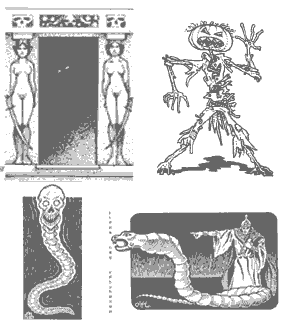
The Fiend Folio had some interesting constructs, too. The scarecrow was of minor interest, but my particular loves from the book were the mid-level danger of Caryatid Columns or the sword and sorcery feel of the Necrophidius and (my personal favorite) the Iron Cobra seemed like perfect elements to throw in as guardians in tombs or servants of evil sorcerers.

Friday, January 8, 2010
Fiend Folio Friday
Among my favorites in the Fiend Folio were the creepy alien humanoids: the spider-like ettercaps, the two-foot tall, nightmare-sending, body-stealing meenlocks, the astral-hunting berbalang, and the shadow-dwelling (and inexplicably explosive) dark creepers and stalkers.
They added a sense of the alien and inscrutable to the campaign, though the meenlock and berbalang both seemed to be a bit of a one-trick pony, the ettercap made a good recurring monster, and the dark creepers and stalkers made a strong basis for a recurring foe or a level or two of megadungeon theme.

They added a sense of the alien and inscrutable to the campaign, though the meenlock and berbalang both seemed to be a bit of a one-trick pony, the ettercap made a good recurring monster, and the dark creepers and stalkers made a strong basis for a recurring foe or a level or two of megadungeon theme.

Friday, January 1, 2010
Fiend Folio Friday
My favorite Fiend Folio monsters were probably the undead. The Apparition, Coffer Corpse, Death Knight, Huecuva, Pennangalan, Revenant, Skeleton Warrior, and Sons of Kyuss all shared the evocative art of Russ Nicholson, and all seemed to be rotting, filthy and nasty. The Death Knights made great Big Bads, the Coffer Corpse and the Sons of Kyuss regular monsters of the day, and all the rest except for the Pennangalan and the Revenant showed up regularly in dungeons I wrote up.
Most of them had great atmosphere -- the Huecuva was an undead monster who could assume other shapes, the Skeleton Warriors and Death Knights with similar tragic histories, and the creepy worm-addled flesh of the Sons of Kyuss gave enough creepiness to fighting these undead to make them more exciting than having just some more zombies and skeletons.

Most of them had great atmosphere -- the Huecuva was an undead monster who could assume other shapes, the Skeleton Warriors and Death Knights with similar tragic histories, and the creepy worm-addled flesh of the Sons of Kyuss gave enough creepiness to fighting these undead to make them more exciting than having just some more zombies and skeletons.

Friday, December 25, 2009
Fiend Folio Friday
 This week's fiends fit into the theme of subterranean bird-men. It was thanks to the Planet Algol blog that I even began thinking of the Dire Corby again. Fearless subterranean pack-hunting bird-men with rock-hard claws and a tendency to shriek "Doom! Doom!", the Dire Corby is a random bit of monstrosity that mechanically looks more or less like any other humanoid.
 Likewise, the armored Hook Horror shares many of these traits, but in a larger, mute, and hard-to-surprise package. Though not intended to work together, they seemed to be pieces of similar design, both having flocks of scary humanoid birdiness with twin rending limbs, both emitting creepy shrieking noises, and both being high on the gonzo "WTF" monster list.
As a teen, my question was always why the heck such things existed in the game world. They seemed silly to me then, but now I see them as potentially alien and surreal, real horrors that hunt the halls of an alien and terrible underworld.
Saturday, December 19, 2009
Some cheap plugs
In which I plug some particularly inspiring blogs I think you should be reading. I have two current favorites that have made for regular entertainment:
- If you enjoy what I do, read Planet Algol. Not only is Planet Algol my top referrer of readers (even above direct links, the RPG Bloggers site, Jim Raggi, and Jeff Rients), but it's a rollicking read that I regularly raid for ideas (and it seems Blair returns the favor, too, which only seems fair.)
- Ancient Vaults and Eldritch Secrets is a constant stream of interesting spells, monsters and magic-items, but his ongoing tales of a morally questionable band of adventurers and their equally questionable rivals is a sheer joy. At first, I missed out on the awesomeness that this blog is because I skipped what I had assumed to be par-for-the-course annoying game fiction, but boy was I wrong. What's wrong with you? Why haven't you gone there already!
Friday, December 18, 2009
Fiend Folio Friday

One of my personal favorites was always the grell. Why? Well, it was a levitating brain with a crapload of paralyzing tentacles, a big beak, and an inexplicable resistance to electrical attacks. I mean, look at that picture. That's the stuff of I-ate-pepperoni-pizza-just-before-bedtime nightmares. There's no point to a giant brain, and no way to figure out what the hell it's doing here. It's a deadly, freaky death-brain, man. And it attacks you 11 times a round, paralyzes you, and then rips the hell out of you the next round. What is there to explain?
Thursday, December 17, 2009




Tuesday, December 15, 2009
Four Major Campaign Villains for Athanor
While it's possible to just do a game of exploration using the Athanor hex map, or to do a long-term dungeon crawl in the Undercity below Zamora, my play style is more to create a campaign where players can actually face a big villain and develop their own sense of a larger purpose. And, frankly, I haven't had a group yet where that wasn't something that they responded well to, even when I was running AD&D 1e back in the early 1980s.
So, in order to provide some room for that kind of gaming, here are four ideas for the Big Bads behind major plots on Athanor. Personally, I would use at least two of these ideas, if not all four.
So, in order to provide some room for that kind of gaming, here are four ideas for the Big Bads behind major plots on Athanor. Personally, I would use at least two of these ideas, if not all four.
- The Witch Kings of Ylum: A handful have survived, locked in deep tombs, as liches. If awakened, they will work on awakening still other witch-kings and strange sorcerous armies of undead and worse.
- The Machines of Aquila: a handful of intelligent and semi-intelligent doomsday devices created by the Empire of Aquila as part of its war on Ylum survive. Seeing the use of magic in the world at large, these machines think Ylum has managed to win the war and, if awakened, these machines will begin to purge the world.
- Mysterious Alien Civilization: Survivors of a crash in the Starfall mountain, the vaguely reptilian, grey-skinned aliens are masters of strange technology. They are amoral, ruthless, and dedicated to conducting experiments on all life in order to find a wy to extend their own.
- The Lords of the Moons: Selune is home to a civilization of alien creatures that live under the surface of the moon. Looking like large jellyfish with brains floating in their centers, the Selunians have powerful psychic powers, advanced technology, and spacecraft. They are served by a race of pale, primitive bird-people with iron-sharp claws called the Corbin. The other moon, Miera, is home to several mechanized, idyllic dome cities in good repair, populated by gold-skinned, pampered urbanites with no ability to survive outside their cities, and no knowledge of the past. The Selunians use them as food, and have built a religion around sacrifices of Mierans to Selunians. There is a problem with the Selunians' food supply, and now the Selunians are beginning to raid Athanor.
Friday, December 11, 2009
Redrawn campaign map.
In trying to rewrite my Athanor materials for self-publication on Lulu, I decided to redraw the campaign map. Here is what I have, done in photoshop:
Scale: 6 miles per hex.

Map key:

Scale: 6 miles per hex.


Wednesday, December 9, 2009
A Maudlin Post for the Holidays
The combination of the holidays and perusing my original AD&D books sends me back to Christmas, 1981. The previous summer, I had become enamored of playing AD&D with friends, and was playing every week. I was deeply obsessed, which I suspect many of you would identify with, even though I didn't even have a Player's Handbook.
That Christmas, I had a stack of goodies under the tree: the Player's Handbook, the Dungeon Master's Guide, the Monster Manual, the Fiend Folio, Deities and Demigods, boxes of official minis from Grenadier, a set of dice, and a set of D&D character sheets-- easily over 100 dollars worth of merchandise which, I realize in retrospect, was a huge cost to my mother. Probably more than we could really afford, actually.
I still have the books and most of the die and even had the figures up till a few years ago, and played using that rule set up through college before moving on to other things. My mother never understood my roleplaying hobby, but she saw it as a passion, and she nurtured it when she saw a spark of something good in what I was doing. She even used it to motivate me to excel in school, to write, to create art, and to keep growing as a person.
She was a clever woman, my mother. This January will be nine years since she passed away, but some days it seems like it was just yesterday that I was opening the packages my mother left for me as if I had found the greatest treasure of my life.
That Christmas, I had a stack of goodies under the tree: the Player's Handbook, the Dungeon Master's Guide, the Monster Manual, the Fiend Folio, Deities and Demigods, boxes of official minis from Grenadier, a set of dice, and a set of D&D character sheets-- easily over 100 dollars worth of merchandise which, I realize in retrospect, was a huge cost to my mother. Probably more than we could really afford, actually.
I still have the books and most of the die and even had the figures up till a few years ago, and played using that rule set up through college before moving on to other things. My mother never understood my roleplaying hobby, but she saw it as a passion, and she nurtured it when she saw a spark of something good in what I was doing. She even used it to motivate me to excel in school, to write, to create art, and to keep growing as a person.
She was a clever woman, my mother. This January will be nine years since she passed away, but some days it seems like it was just yesterday that I was opening the packages my mother left for me as if I had found the greatest treasure of my life.
Wednesday, December 2, 2009
Finding my way in all this stuff I have created.
As the quarter comes to a close and leaves me to spend a winter break cuddling up with Bourdieu and Foucault to find a way to develop an theory of cultural and personal resiliency that explains how marginalized students create agency and places of resistance within culturally hegemonizing forces (can you tell I'm a graduate student?), I also find myself with relatively more time to work on Athanor.
I think that with Athanor, I am not interested as much in pure hexcrawling sandbox play (though I have been working on material for hexcrawling in Athanor) and I don't really find megadungeons as compelling (and I have maps for that at least). Instead, I want to find a way to "map" out interesting social settings, roleplay opportunities, and chances for adventure. So I have been thinking about the kinds of thing that feel like they are part of the right genre:
I need to put this stuff together into a set of possible encounters and come up with a relationship between all the pieces.
And then, I need to stop thinking so much about it all. Maybe run a game.
I just got my Google Wave invite. At some point in the near future, I'll have to start recruiting players. Right now, I need to do present a pilot study for my dissertation, revise my written report for the quarter, and then take a long nap.
I think that with Athanor, I am not interested as much in pure hexcrawling sandbox play (though I have been working on material for hexcrawling in Athanor) and I don't really find megadungeons as compelling (and I have maps for that at least). Instead, I want to find a way to "map" out interesting social settings, roleplay opportunities, and chances for adventure. So I have been thinking about the kinds of thing that feel like they are part of the right genre:
- Love interest of the hero kidnapped, heroes must pursue.
- Pursuing villains into ruins filled with terrible monsters.
- Weird science gone amok in the hands of a mad scientist.
- Intelligent but barbaric alien war-bands.
- Averting war between kingdoms.
- Sky-pirate raids.
- Death-traps.
- Gloating villains.
- Villains who are actually guardians of a secret history of Athanor.
- Exotic locales.
- Strange fauna.
- Getting lost far from home.
I need to put this stuff together into a set of possible encounters and come up with a relationship between all the pieces.
And then, I need to stop thinking so much about it all. Maybe run a game.
I just got my Google Wave invite. At some point in the near future, I'll have to start recruiting players. Right now, I need to do present a pilot study for my dissertation, revise my written report for the quarter, and then take a long nap.
Monday, November 30, 2009
Crabmen, Dire Corbies, and the like.
A recent Planet Algol post made me think of a long-lost-to-my-subconscious old Fiend Folio monster, the Dire Corby. Issue 3 of Fight On! magazine made me think back to the Fiend Folio's Crab Men. Makes me think about the great potential for totally gonzo weirdness in my monsters in the old Fiend Folio, if only I let the weirdness of the monsters become their strength rather than their weakness.
Perhaps that way lies madness, but I think there may be genius in reclaiming monsters like the Flail Snail....
Perhaps that way lies madness, but I think there may be genius in reclaiming monsters like the Flail Snail....
On the Nature of Magic in Athanor
At first, I had thought there would be no magic in Athanor, at least not at first. One version of Athanor used the magic system from Grim Tales, while another used the D&D 3.5 version of rituals as presented in Unearthed Arcana. Another version used powers from True20, and still another tried to use psionics or psychic powers.
I have had trouble with magic and Athanor.
Part of me wants to dismiss with magic entirely, and be purely Sword and Planet. Another part of me wants difficult and grim rituals, and be heavily Sword and Sorcery, but in the end I decided to go with something that makes for easier game play and sacrifice a little flavor.
So what is magic on Athanor? Here are three options for why it exists in game:
I have had trouble with magic and Athanor.
Part of me wants to dismiss with magic entirely, and be purely Sword and Planet. Another part of me wants difficult and grim rituals, and be heavily Sword and Sorcery, but in the end I decided to go with something that makes for easier game play and sacrifice a little flavor.
So what is magic on Athanor? Here are three options for why it exists in game:
- Athanoran magic was purely psychic in nature. Thus magic-users have developed and trained psychic ability, rogues have a wild latent talent, and fighters have no psychic talent.
- Athanoran magic involves binding spirits in service to the caster, which is why limited numbers of spells can be prepared. Casting spells involves commanding spirits to do a task. Failure to control a spirit means that it is freed from its bonds and obligation.
- Athanoran magic is achieved by creating matrices of magical energy in the mid of the caster which allow direct, specific manipulation of matter and energy. The matrices are fragile, and failure to maintain proper control and guidance will cause the matrix to collapse.
Tuesday, November 24, 2009
Update of sorts
My Athanor supplement is nearing completion when I have free time. I have an original, but not particularly well-done cover for the book, and I want to revisit the skill system to see if I can strip it down more and make that section cleaner.
Most of my time is being spent on school. By the end of the week, I should have finished a 35 page-ish paper (including bibliography and appendices -- only about 25-30 pages of real content), put together a 10-minute presentation of the paper, and made copies of my video project. Then the quarter will be done and I have until January to take some "time off" from class (a values of "time off" that includes reading some Foucault, Gramsci, Freire, Apple, Illitch and miscellaneous journal articles.) I just got my dissertation committee chair and I have made a good first pass at outlining and starting to flesh out a literature review, and have a good idea of big gaps. My next six months are going to kill me, as I need to take two classe per quarter and really wrestle with methodology and the development of an Institutional Review Board (IRB) proposal for human research, both for access to retention and graduation data from the institution and for interviews of students.
As a result of this pre-dissertation proposal madness, thinking about gaming has not been a high priority -- even though I will be gaming tonight and in a couple of weeks with my friends' 4e groups. But playing 4e has really gotten me thinking about some of the weirdness of contemporary gaming that makes me re-think the way I have approached the hobby for the last decade or two.
When I was a wee lad arond '81, we didn't have detailed backstories. We didn't set up "3 by" backgrounds for our PCs (which, I have to admit, I introduced to the my friend a few years ago and a D&D 3.0 game). Instead, we rolled up a quick character, and slowly accreted a background as we thought about it. Starting characters were cyphers, and only gained depth with survival. It's almost as if we were trying not to be attached to the FNG until he survived a few firefights. Background information was a sign of long-term survival.
Nowadays, D&D (and this applies to 3.x, too) takes more effort to make a character, and we tend to invest characters with things like backgrounds, and ideas of destiny and future as a result. But the important things here are a) that players don't want to lose characters as a result (though my Tiefling Swordmage, Malachi Skaith has a bit of a deathwish, and I don't count on him surviving until the end of the campaign), and that getting into the hobby involves a higher commitment on the part of players. Characters take more time to make, more systems mastery to make, and more storytelling skill to make.
This isn't a rant on the evils of contemporary D&D. Certainly, this very issue of complexity and ability to make the character I wanted moved me away from D&D to other games by the time I was in college. However, I wonder if the lack of ease of getting up and running as a new player is an issue for people new to the hobby, and not an incentive to just toss together a character on an MMORPG and get the gameplay and table chatter with a lot less effort.
Most of my time is being spent on school. By the end of the week, I should have finished a 35 page-ish paper (including bibliography and appendices -- only about 25-30 pages of real content), put together a 10-minute presentation of the paper, and made copies of my video project. Then the quarter will be done and I have until January to take some "time off" from class (a values of "time off" that includes reading some Foucault, Gramsci, Freire, Apple, Illitch and miscellaneous journal articles.) I just got my dissertation committee chair and I have made a good first pass at outlining and starting to flesh out a literature review, and have a good idea of big gaps. My next six months are going to kill me, as I need to take two classe per quarter and really wrestle with methodology and the development of an Institutional Review Board (IRB) proposal for human research, both for access to retention and graduation data from the institution and for interviews of students.
As a result of this pre-dissertation proposal madness, thinking about gaming has not been a high priority -- even though I will be gaming tonight and in a couple of weeks with my friends' 4e groups. But playing 4e has really gotten me thinking about some of the weirdness of contemporary gaming that makes me re-think the way I have approached the hobby for the last decade or two.
When I was a wee lad arond '81, we didn't have detailed backstories. We didn't set up "3 by" backgrounds for our PCs (which, I have to admit, I introduced to the my friend a few years ago and a D&D 3.0 game). Instead, we rolled up a quick character, and slowly accreted a background as we thought about it. Starting characters were cyphers, and only gained depth with survival. It's almost as if we were trying not to be attached to the FNG until he survived a few firefights. Background information was a sign of long-term survival.
Nowadays, D&D (and this applies to 3.x, too) takes more effort to make a character, and we tend to invest characters with things like backgrounds, and ideas of destiny and future as a result. But the important things here are a) that players don't want to lose characters as a result (though my Tiefling Swordmage, Malachi Skaith has a bit of a deathwish, and I don't count on him surviving until the end of the campaign), and that getting into the hobby involves a higher commitment on the part of players. Characters take more time to make, more systems mastery to make, and more storytelling skill to make.
This isn't a rant on the evils of contemporary D&D. Certainly, this very issue of complexity and ability to make the character I wanted moved me away from D&D to other games by the time I was in college. However, I wonder if the lack of ease of getting up and running as a new player is an issue for people new to the hobby, and not an incentive to just toss together a character on an MMORPG and get the gameplay and table chatter with a lot less effort.
Thursday, November 12, 2009
Apparently, Geekdo is much more thorough than I thought.
Apparently, someone has made a page for Savage Swords of Athanor on Geekdo based on my files made available on Scribd, and I have a very empty creator page there.
This strikes me as rather odd, as I don't exactly pull a lot of traffic here, but it's vaguely flattering I guess.
But it's clear to me now that Geekdo is very, very complete.
This strikes me as rather odd, as I don't exactly pull a lot of traffic here, but it's vaguely flattering I guess.
But it's clear to me now that Geekdo is very, very complete.
Thoughts on defeat
Right now, I am preparing to do a write-up of a pilot study for my upcoming dissertation methodology, but still need to conduct an interview as part of that. The problem is, my initial study was a complete, dismal failure. Which on some levels isn't particularly surprising-- the kinds of problems I had in data collection were unsurprising, but still disappointing. So my report on the pilot study will be a reflection on problems, my 10% response rate, how that will complicate data collection and sampling, and alternative approaches to my research.
This comes as my friend Rich's 4th edition game faced our first major defeat. No big deal to me -- I have been gaming since 1981. I have faced worse defeats. My friend Will, who just started playing RPGs this year, was gobsmacked. We had regularly fought through some very tough circumstances, but this time, we had our asses handed to us, one of us was captured, and the rest of us left to retreat and regroup thanks to the sacrifice of Will's character.
Which all makes me think about the issue of defeat. One of the reasons I don't so much love killing off PCs is that I like the idea that defeat shouldn't be the end. Defeat is dramatic. Defeat is exciting. Defeat is motivating. This may be part of the reason that my favorite film in the original Star Wars saga has always been The Empire Strikes Back: it's the most fulfilling of the three films. Why? Because the bad guys lose. The rebel base on Hoth is destroyed. Han Solo is captured and carried away by Boba Fett. Luke loses a hand and finds out he's Vader's son. There's betrayal and self-doubt. And a seed of hope. A lot happens, and real investment in purpose and outcomes here.
Now, you can't have every game end in defeat or it will become boring and frustrating. But defeat serves a purpose, and a good one at that, by building tension and engagement. And teaching the players to think and consider options out of that defeat.
This comes as my friend Rich's 4th edition game faced our first major defeat. No big deal to me -- I have been gaming since 1981. I have faced worse defeats. My friend Will, who just started playing RPGs this year, was gobsmacked. We had regularly fought through some very tough circumstances, but this time, we had our asses handed to us, one of us was captured, and the rest of us left to retreat and regroup thanks to the sacrifice of Will's character.
Which all makes me think about the issue of defeat. One of the reasons I don't so much love killing off PCs is that I like the idea that defeat shouldn't be the end. Defeat is dramatic. Defeat is exciting. Defeat is motivating. This may be part of the reason that my favorite film in the original Star Wars saga has always been The Empire Strikes Back: it's the most fulfilling of the three films. Why? Because the bad guys lose. The rebel base on Hoth is destroyed. Han Solo is captured and carried away by Boba Fett. Luke loses a hand and finds out he's Vader's son. There's betrayal and self-doubt. And a seed of hope. A lot happens, and real investment in purpose and outcomes here.
Now, you can't have every game end in defeat or it will become boring and frustrating. But defeat serves a purpose, and a good one at that, by building tension and engagement. And teaching the players to think and consider options out of that defeat.
Subscribe to:
Posts (Atom)
