Showing posts with label 5th edition. Show all posts

Friday, February 13, 2015

Fiend Folio Friday: Dark Creeper and Dark Stalker

Dark Creeper

The dark creeper (a folk name for the race since the race name is unknown and the race language incomprehensible to linguists) is a humanoid, slightly-built creature about the same height as a dwarf. Members of the race always dress in sombre, dark-coloured clothing, concealing as much of their pallid skin as possible. They detest light and dwell deep underground — usually leading a solitary existence though there have been rumours of underground villages inhabited by as many as 80 individuals, including 20%—25% females. These villages are always ruled by a dark stalker.

Petty Thieves

The dark creeper is particularly fond of small magical items such as rings and magic daggers — solitary individuals will carry 25% of their treasure in the copious pockets of their cloaks in the form of trinkets, small jewelry, gems and coins.

Dark Creeper
Small humanoid
Armor Class: 17 (13 in normal or better light)
Hit Points:  7 (2d6)
Speed:       20 ft
STR 8 (-1), DEX 16 (+3), CON 10 (+0), INT 10 (+0), WIS 10 (+0), CHA 10 (+0)
Skills:      Acrobatics +5, Perception +2, Sleight of Hand +5, Stealth +5
Senses:      Darkvision 120 ft, detect magic 15 ft, passive Perception 10
Languages:   Dark creeper, undercommon

Creature of Darkness
The creeper  has the innate power to create darkness once per short or long rest — this power acts as the darkness spell, but does not affect dark creepers. During this time the creeper has two main objectives. First, to destroy lanterns and tinderboxes, break flasks of oil and so on — any act which will inhibit the creation of illumination. Secondly, to steal any small magical items detected. Self-preservation ranks marginally above such objectives.

Armored in Shadow
The dark creeper adds +4 to its armor class when in dim illumination or darkness. They are experts in using the shadows as cover for their activity.

Heatless Fire
When the Dark Creeper dies, its body undergoes a rapid transformation, releasing the dark energies inside it. All within 10 feet tahe 3 (1d6) necrotic damage and are blinded one round, or half damage and no blindness if they make a CON save (DC 20)

Actions
Poisoned Dagger, melee weapon attack, +5 hit, 5 foot reach, 1 target, 5 damage (1d4+3 plus poison — save DC 10 or extra 2d6 poison damage).

Dark Stalker

Dark stalkers are the rarely-seen leaders of the dark creepers. They are nearly a race apart, for they breed almost exclusively amongst themselves. They are instantly noticeable amongst a group of dark creepers as they are man-sized and stand head and shoulders above their underlings.

There is an average of one dark stalker to every 25 dark creepers, and each dark creeper village will contain at least one stalker ruler. Stalkers will rarely be encountered on their own, but this has been known to happen as the stalker goes about some mysterious personal mission.

They fight with short swords if they must, and some of these are magical (25% chance). All of their treasure is carried — there is a 7% chance of a magical ring and a 12% chance of 2—5 gems or 1 —2 items of jewellery on any given individual encountered. If attacked in normal illumination, the dark stalker has AC8.

If killed, a dark stalker explodes in a blinding flash equal to a 3-dice fireball.

Dark Stalker
Armor Class: 16 (12 in normal or better light)
Hit Points:  23 (4d8+5)
Speed:       20 ft
STR 10 (+0), DEX 15 (+2), CON 13 (+1), INT 10 (+0), WIS 10 (+0), CHA 10 (+0)
Skills:      Acrobatics +4, Perception +2, Sleight of Hand +4, Stealth +4
Senses:      Darkvision 120 ft, detect magic 15 ft, passive Perception 10
Languages:   Dark creeper, undercommon

Creature of Darkness
The dark stalker  has the innate power to create darkness once per short or long rest — this power acts as the darkness spell, but does not affect dark creepers. During this time the creeper has two main objectives. First, to destroy lanterns and tinderboxes, break flasks of oil and so on — any act which will inhibit the creation of illumination. Secondly, to steal any small magical items detected. Self-preservation ranks marginally above such objectives.

Create Fog
The dark stalker can use the Wall of Fog spell once per short rest.

Armored in Shadow
The dark stalker adds +4 to its armor class when in dim illumination or darkness. They are experts in using the shadows as cover for their activity.

Heatless Fire
When the Dark Creeper dies, its body undergoes a rapid transformation, releasing the dark energies inside it. All within 10 feet take 10 (3d6) necrotic damage and are blinded one round, or half damage and no blindness if they make a CON save (DC 20)

Actions
Poisoned Shortsword, melee weapon attack, +5 hit, 5 foot reach, 1 target, 5 damage (1d6+2 plus poison — save DC 10 or extra 2d6 poison damage).

Thursday, February 12, 2015

Magic Item: Book of Ebon Bindings

The players in my game recently found a magical book. It's a bit powerful, even though I don't use many magic items, but its role is pretty limited in granting power to the character. (All respect to Dr. M.A.R. Barker, from whom I stole the title of the Book).

BOOK OF EBON BINDINGS

Wondrous Item, legendary (requires attunement)
The Book of Ebon bindings was granted as a gift to the wizard Hassan Al’Akar from a fiendish tutor. It is a black gook gound in black iron and inscribed with runes. It is warm to the touch, and its presence makes celestials uncomfortable.

MINOR PROPERTY

The book whispers warnings of danger to its bearer, granting +2 to initiative if the bearer isn’t incapacitated.

QUIRK

Hungry: the Book’s magical properties function only if fresh blood from a humanoid has been applied to it within the past 24 hours. It needs only a drop to activate.

ATTUNEMENT

To use the Book of Ebon Bindings, a character must attune to the book. In addition to spending a short rest focused on the book, the user must speak aloud the ritual of attunement written in the front of the book.

ARCANE SECRETS

A character attuned to the Book of Ebon Bindings has advantage on Intelligence (Arcana) and Intelligence (Religion) checks.

CANTRIPS

A character attuned to the Book of Ebon Bindings has access to the three following cantrips, which can be cast at will: Blade Ward, Fire Ward, Poison Spray.

RITUAL OF AUGURY

A character attuned to the Book of Ebon Binding can cast Augury as a ritual.

POWER OF FEAR

The Book has 5 charges. It regains 1d4+1 expended charges daily at dawn. If you expend the last charge, roll 1d20. On a 1, the book will not be able to use its fear powers for 2d6 days.

Command: while reading from the Book of Ebon Bindings, you can use an action to expend 1 charge and command another creature to flee or grovel, as with the Command spell (save DC 15)

Cone of fear: while reading from the yBook of Ebon Bindings, you can use an action to expend 2 charges, creating a 60 foot cone of black energy. Each cyreature in the cone must succeed in a DC15 Wisdom saving throw or become frightened of you for 1 minute. While it is frightened in this way, a creature must spend its turns trying to move as far away from you as it can, and it can’t willingly move to a space within 30 feet of you. It also can’t take reactions. For its action, it can use only the Dash action to try to escape from an effect that prevents it from moving. If it has nowhere it can move, the creature can use the Dodge action. At the end of each of its turns, a creature can repeat the saving throw, ending the effect on itself on a success.

SENTIENCE

The Book of Ebon Bindings is a sentient, neutral evil wondrous item with an Intelligence of 15, a Wisdom of 13, and a Charisma of 8. It has hearing and darkvision out to 120 feet. The Book of Ebon Bindings communicates by means transmitting emotions to the character carrying it. Its special purpose is that it believes that it and its wielder have key roles to play in future events.

PERSONALITY

The Book of Ebon Bindings is arrogant and ruthless. It sees its role as essential, as its its master, but it has a tendency to see all other creatures as disposable. It tires to guide its possessor toward power, dominance, and furthering the powers of evil. It guides its user with fear, anger, resentment, and desire to perform act of revenge, violence, and pursuit of power.

SIDE EFFECT

While you are attuned to the Book of Ebon Bindings, animals will be hostile to you,  plants that aren’t creatures wilt and die within ten feet of you, and holy water within 10 feet is destroyed .

Friday, February 6, 2015

Fiend Folio Friday: Crabmen and Dire Corbies

This week, my Fiend Folio entries focus on basic grunt monsters from the original Folio. My rewrites give little twists to both of these monsters, but keep them as low-level thugs with a little different flavor.

Crabmen

Amphibious creatures usually found in sea-shore caves, crabmen are nine foot tall humanoids but with a hard, reddish-brown exoskeleton. Instead of hands they have two pincers.

Crabmen greatly value silver and will go to any lengths to obtain it, even attacking a character suspected of carrying any item made of this metal. In normal circumstances, however, they are quite pacific creatures, though from time to time an instinct makes them leave their coastal dwelling to mount a savage raid inland, roaming in bands of 30 or 40 creatures and pillaging all property in their path, not hesitating to attack those who would defend.

Crabmen are often subjected to raids by sahuagin who consider them a tasty delicacy. However the sahuagin's usual net-throwing tactics are ineffective against crabmen since the latter's natural weaponry allows them to cut through nets very quickly.

Crabman
Large humanoid, neutral
Armor Class:         15
Hit Points:             38 (6d10 +5)
Speed:                    20 feet, 15 feet swimming
STR 14 (+2), DEX 14 (+2), CON 13 (+1), INT 8 (-1), WIS 10 (+0), CHA 6 (-2)
Skills:               Athletics +4, Perception +2
Senses:             Tremorsense 30 feet, Passive Perception 12
Languages:       Aquan, Common

Actions
Pincers: melee weapon attack, reach 5 feet, one target, hit 7 (2d4+2) slashing damage. A creature struck by the crabman must roll a Strength save (DC 12) or become grappled.

Dire Corby

This subterranean race of huge black bipedal birds contains ferocious fighters which need never check morale. Long ago the dire corbies lost the power of flight; however they make up for this with their great strength and ferocity, always attacking and fighting to the death. What were once wings have now developed as two powerful arms which end in sharp, rock-hard claws.

They hunt in flocks, running down their hapless victims, at the same time emitting horrifying shrieks. They have rudimentary language (their attack cry can be recognised as 'Doom! Doom I' by those familiar with it).

Dire corbies live in large underground caverns; at one time there was open warfare between them and giant bats, but this has now become an uneasy truce.

Dire Corby
Medium humanoid, neutral evil
Armor Class  15
Hit Points:       26 (4d8+8)
Speed:              40 feet
STR 14 (+2), DEX 15 (+2), CON 15 (+2), INT 8 (-1), WIS 12 (+1), CHA 8 (-1)
Skills:               Perception +3, Stealth +4
Senses:             Darkvision 120 feet, Passive Perception 13
Languages:       Dire Corby


Disorienting Shrieks: Creatures within 20 feet of a dire corby must succeed on a DC 10 Wisdom saving throw, or it can’t take reactions until the end of its next turn. On its turn, the target can’t move, and it uses its action to make a melee or ranged attack against a randomly determined creature within range. If the target can’t attack, it does nothing on its turn.

Actions
Claws: melee weapon attack, reach 5 feet, one target, hit 9 (2d6+2) slashing damage.


Thursday, February 5, 2015

Estarion, Game 13

The game was one of those tie-up-loose-ends games. The heroes mostly spent some time reviewing clues at the party before doing some research and follow-up. The heroes abscond with the body of the intellect devourer and its erstwhile host. They used their magic and skills to carry the body to the priestesses of Astarte to get them to use Speak with Dead to find out what the host knew.

The heroes learn a little about how the host was taken, but are no closer to learning what the bad guys know. Ana lets Tatiana Scaevola know about the death of their man, which unnerves her. Jarret lets slip to Marcellus Nonus that his ally was killed, which upsets the necromancer. Then the heroes begin to regroup. The heroes find that Nonus' house is ransacked by the Guard, and look for clues, finding very minor ones that just confirm Nonus' connection to the cult of Orcus.

At the end of the game, Nonus sends some ghouls, and Arturius is again out cold.

The heroes know the Orcus cultists are disturbed, and that they don't even know who else is hunting them.

Friday, January 30, 2015

Fiend Folio Friday: Berbalang

I yet again revisit my love of the Fiend Folio in order to provide a new adaptation of a Fiend Folio creature for 5th edition. I'm going to try to do this once per week for a while, skipping to the creatures I actually like or wished I could like and loosely going in alphabetical order.

I will certainly alter details to suit my own idea of what would be improvements to the creature, so while these will largely be true to the source, don't count on slavish devotion to reproducing creatures.

Berbalang

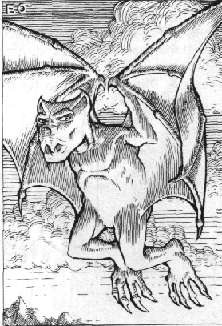
The berbalang is a solitary biped with leathery skin and bat-like wings. Its eyes are white and watery. DM note: the Berbalang is a low-level mystery monster, a terror that strikes and returns no matter what the PCs do. It's a menace that strikes at and devours people in a village, and even when the PCs are able to kill it off, it comes back looking for revenge, perhaps multiple times, until its lair can be found and the creature killed.

A Dual Life on the Astral Plane

The creature spends the greater part of each month in an apparently dormant state, hibernating preferably in a well-hidden cave. Though seemingly comatose, the berbalang is actually roaming the Astral Plane where it spends its time hunting and killing creatures weaker than itself and engaging in bizarre and complex courtship and mating rituals with other berbalangs. If its body is discovered and interfered with during the creature's astral roaming, the berbalang will attempt to return to the body and animate it; however this can take a long time (1-100 rounds) depending on the berbalang's actual distance away across the planes. If the body is destroyed, the astral berbalang dies as well. For this reason the creature takes a great deal of care in hiding itself and is very ingenious in this regard.

Duplicate Projection 

For three days each month at the time of the full moon, the berbalang returns to its material body, only to alter its form of trance and send forth a physical projection of itself upon the Prime Material Plane. The projection flies in search of food — a freshly-killed human corpse. The projection is physical in the sense that it can receive and inflict damage — in this respect it is a duplicate of the original. The berbalang can use all of the senses of the projection and will command (and essentially 'is') the projection in its quest for food. The projection can range up to 3 miles from the material berbalang body. The projection fights, if it needs to do so.

If the projection is hit and suffers damage it immediately takes flight, returning  to the body which will be unable to project again for a number of days equal to the number of hit points lost. If the projection is 'killed' it disappears, and the berbalang must make a DC10 CON save. If it fails the save, it falls to 0 hit points..

If the berbalang survives an attack, it will eventually seek revenge upon its attacker, though this may be delayed while the body recovers. If a wounded projection is followed back to the berbalang lair, the followers may be taken aback when they confront the unwounded physical creature.

If the protection is forced back to the body before the berbalang was able to feed, or if the projection was destroyed before feeding, a new projection will go forth again as soon as possible (after the compulsory period of recovery) regardless of the phase of the moon.

Sneaky Bugger  

To keep from depleting its food supply or arousing too great a local alarm, a berbalang will move its physical body to a new area every three or four months. They always travel by night and avoid confrontations when they are actually physically present. Since berbalangs live on the edge of civilisation, where lack of organisation allows them free rein, a berbalang is very rarely encountered in its physical form unless adventurers happen upon its lair or follow its projection back to its body.

Eat on the Run

If a projection kills a human it will immediately pick up the body and fly, at full rate, back to the host which will immediately emerge from its trance. While in flight, the projection will be feeding on the body — a fully-grown human can thus be devoured in one turn, leaving only the bones, garments and equipment.

WTF? 

How the berbalang derives sustenance when only its projection feeds, and how it reproduces when all mating activity takes place on the Astral Plane, are mysteries so far unexplained.

Berbalang


Medium humanoid, chaotic evil

Armor Class: 13
Hit Points: 19 (3d8+6)
Speed: 30 feet, 60 feet flying

STR 10 (+0), DEX 16 (+3), 14 CON (+2), INT 15 (+2), WIS 13 (+1), CHA 10 (+0)

Skills: Perception +3, Stealth +5
Senses: Darkvision 120 ft., passive Perception 13
Languages: Common, Deep Speech
Challenge: 1


Actions

  • Multiattack: the berbalang attacks with its claws and a bite.
  • Claws: melee weapon attack, +5 hit, reach 5 feet, one target 8 (2d4+3) slashing damage.
  • Bite: melee weapon attack, +5 hit, reach 5 feet, one target 6 (1d6+3) piercing damage.

Saturday, January 3, 2015

Converting Fiend Folio Favorites: Caryatid Column

Caryatid columns are created much like stone golems. The column appears to be a column incorporating the form of a slim woman bearing a narrow, old-fashioned sword, about 7' tall.

Defensive functions. A caryatid column will always have a specific defensive function such as guarding a treasure-chest or preventing intrusion into a particular area. This task will have been set by the creator.

The caryatid column will 'activate' as soon as any act is committed which its task specifically prohibits — the approach of a potential thief towards the treasure the column has been set to guard, an intrusion into a 'forbidden' area and so on. When it does animate, the caryatid column takes on a fleshy appearance, the sword, becomes steel and it is this weapon that the caryatid column will use in melee if necessary.

However the caryatid column will not necessarily enter into combat; its main task is to guard the treasure, prevent intrusion into a particular area or another similar task and if it can carry out this task without combat it will attempt to do so. Its behaviour will depend a great deal on the circumstances and the instructions given by its creator but it might, for example, attempt to divert the attention of intruding adventurers from the forbidden area and lead them to a place where they will be trapped or attacked by a monster.

If combat is inevitable, however, the caryatid column will initiate it. When the caryatid column's task is complete — intruders killed, treasure no longer vulnerable, for example — it will return to its original position and revert to its original stone shape, the sword becoming stone as well. If the column is killed, it returns to stone (as does the sword) on the spot.

Medium Construct, Unaligned

Armor Class:    15
Hit Points:         37 (5d8+15)
Speed:             30 ft, climb 30 ft

STR 16 (+3); DEX 14 (+2); CON 16 (+3); INT 3 (-4); WIS 10 (+0); CHA 10 (+0)

Damage Immunities: Psychic, poison.
Condition Immunities: Charmed, exhaustion, frightened, paralyzed, petrified, poisoned.
Damage Reduction: Bludgeoning, Piercing or Slashing damage from non-magical weapons that are not adamantine. Senses: Darkvision 120 ft., passive Perception 10
Languages: Understands the languages of its creator, but does not speak.

Immutable form: The caryatid column is immune to any spell that or effect that would alter its form.

Magic resistance: The caryatid column has advantage on saving throws against spells and other magical effects.

Weapon breakage: Any nonmagical weapon that strikes the caryatid column has a 25% chance (not cumulative) per strike of breaking.

ACTIONS

Sword: +5 melee weapon, reach 5 feet, 8 (2d4+3) slashing damage.

Monday, December 15, 2014

Three Sentient Magic Items: a rough draft.


I have noted before that I have an aversion to simple magic items, particularly ubiquitous +1 weapons and the like. I dislike how they provide an escalating pile of bonuses, how dull they are, and how they become part of the implied power economy of the game. 

That said, magic items are fun to write up. I have been thinking of bringing in some magic items to the campaign, and I have started writing up some basic descriptions. These are rough drafts for the items thus far. They are all three intelligent items, sort of mini-artifacts for my campaign.

Nimal Yaad, Trident of the Sea Lords

Weapon (trident), rare (requires attunement)
This was an ancient weapon of the Sea Lords of Kania, a symbol of their rule. The Trident marks its carrier as a ruler, the captain of his vessel, and a merchant lord among his people. The Trident came to Estarion with early traders when the city was a minor trading outpost, and was used as a weapon in battle against the Three Sisters by Abdeshmun Zinn, who fought alongside the Avatar of Astarte when the Three Sisters first sought to conquer the land. Nimal Yaad was lost decades later when Behdoun raiders destroyed the temple of Yam and took the trident as spoils of war. It was later recovered by priests of Poseidon, where it became a holy relic of Poseidon until the trident disappeared in a war with the Parsian invader Xanaton the Younger.

·      You gain a +1 to attack and damage rolls with this magic weapon.
·      You gain advantage on Charisma checks while holding Nimal Yaad.
·      You gain proficiency on Intelligence checks to appraise goods.
·      While bearing Nimal Yaad, you can use an action to cause your voice to carry up to 300 feet until your next turn.

Sentience: Nimal Yaad is a lawful neutral weapon with an Intelligence of 8, a Wisdom of 10, and a Charisma of 14. The trident has hearing and normal vision out to 60 feet and communicates by transmitting emotions to the creature carrying or wielding it.

Personality: Nimal Yaad was built for glory. It will drive its user to feats of combat and glory if possible. Made to serve merchant-kings, the weapon is less a powerful combat weapon than a useful symbol of leadership.

The Harvester

Weapon (greataxe), rare (requires attunement)
Forged, it is said, by Dagon, god of grain and field, as a weapon to defend his worshipers from raiding tribes, this axe is blessed by the virgin goddess of war and violence, Anat. The Harvester is a double-bitted long axe covered with runes and symbols. It came to the region in the hands of the Kanian Paladin Niqmad, who drove out a nest of goblins to help found Selindra. The harvester was passed to Niqmad’s sons, and only disappeared as the Aquilans came to rule the region.

·      You gain a +1 to attack and damage rolls with this magic weapon.
·      The Harvester is a vicious weapon.
·      The Harvester is made with cold iron, silver, and magic.
·      The Harvester whispers warnings to its users of danger, giving him or her a +2 bonus to initiative.
·      The Harvester acts as a ring of protection +1 (+1 saves and armor class) while it is wielded.
·      The Harvester is unbreakable.

Sentience: The Harvester is a chaotic neutral weapon with an Intelligence of 10, a Wisdom of 12, and a Charisma of 10. The trident has hearing and normal vision out to 120 feet and communicates by transmitting emotions to the creature carrying or wielding it.

Personality: The Harvester is has a love of battle and danger. It is always ready to guide its owner into conflicts, and to seek out the most powerful foe it can. It is easily bored and generally pretty impatient. It tends to be suspicious of strangers.

The Robe of Shadows

The Robe, it is said, was woven by Hecate, and given as a gift to the merchant Estarius. The black robe is woven of spider silk and enchanted to be indestructible, always clean, able to adjust to whomever wears it. The robe disappeared years ago, and it has always been assumed it was stolen long ago.

·      The robe acts as a Cloak of Invisibility.
·      The robe acts as a Cloak of Protection.
·      Gleaming: the robe never gets dirty.
·      Unbreakable: the robe can’t be broken. Special means must be used to destroy it.\

Sentience: The Robe of Shadows is a chaotic neutral robe with an Intelligence of 12, a Wisdom of 12, and a Charisma of 8. The trident has hearing and darkvision out to 120 feet and communicates by speaking, reading, and understanding High Aquilan.

Personality: The robe is haughty and demanding. It sees itself as a tool of great wizards, and has a disdain for non-wizards. It tends to push its master to preserve him or herself at any cost, sees non-wizards as expendable, and wants to see it and its master properly adorned and presented. It is ambitious for its master and, by extension, for itself.

Wednesday, December 3, 2014

Estarion, Game 8

Another game without combat and heavy on the roleplay. That actually wasn't what I had planned, but these players constantly go left when I plan to go right.

Regrouping at the temple, Arturius brings back some friends, Timonitus the Invoker and Anakis the Tiefling Bard. The group began investigating further into the activities of the Cult of Orcus, but moving cautiously. They begin three investigations: one into the asylum of Marcellus Novus, one into the brothel of Tatiana Scaevola, and one into the city orphanage, running simultaneously.

At the Asylum, Timonitus and Jarret try to investigate, and Jarret manages to get a job there, playing off that he is an apprentice wizard with skills in medicine and an interest in studying physiology and life and death. After an interview and a day at work, Jarret has a sense of the layout of the asylum and is doing a bit of a dance with Marcellus to feel out the place. He does learn that the inmates seem to be well-preserved zombies, the guards are not necessarily human, either.

At the orphanage, Arturius and Carver learn that the orphans who died at the orphanage really did seem to die from the Penanggalan, and coordinate efforts of priests of Apollo and Hades to try to protect the place from undead attack. Meanwhile, Meadow learns that Herminia Cassius’ maid has bruises and seems to be hiding problems at the Cassius’ home. Herminia may be getting hangry.

Meanwhile, Anakis investigated the brothel. Identifying a mark who was a client at the brothel, Claudius Blandus, Minister of Ratcatchers. She tried to get a lead on employment to get inside the brothel, but Blandus was deeply nervous about her requests for employment if they began to stray near the brothel. An attempt by Meadow to join in pushes too hard and he leaves. But afterward, Anakis goes through a gift box Blandus leaves her and finds sweets, a bottle of perfume, and a creepy book of misogynistic sadistic “erotic” poetry. Skeeved out, she still meets him again, again with backup, and Blandus, seeming distant, says he can get her an appointment with an employer and takes her to Scaevola’s brothel. Anakis talks her way out of being assassinated, and ends up instead being hired to spy on Arturius and his ragtag group. Anakis also finds more reasons to be suspicious of the brothel.

Meanwhile, the party jumps Blandus and tries to convince him to talk, but he’s too scared of Scaevola to do so. Eventually, they off him and make it look as if the last remaining wererats from the Rat Cult got to him, and fence some of his goods in a disguise to help confound their role in his murder.

Next game, the city will be in trouble, and there will be a combat-heavy game.

Wednesday, November 26, 2014

Estarion, Game 7

A few days pass and Arturius and Carver find themselves called to work with the church elders, leaving Jerrit and Meadow to investigate. They spend a couple of days investigating the people on the list of names they captured in game 3:
  • Finding the tomb of Vitus Pontius, they end up attacked by his corpse, revitalized as a coffer corpse, which the pair defeats after Jerrit suffers a little strangulation.
  • The two decide they can't really touch Lucanus Valens, chief of the guard or Nevius Albanus, Imperial Master of Keys.
  • Meadow makes friends with one of Lady Herminia Cassius' servant Prisca in the market, gets to know her and uses her face to infiltrate the Lady's home. They find that Lady Herminia stays young with a nightly bath in vinegar that Prisca leaves drawn for her each night. Prisca tells Meadow that her mistress is traveling right now and not available. Meadow, wearing the appearance of Prisca, finds that there is still a fairly recent residue of vinegar in the tub, and brings a rag soaked with what she wiped up. Jerrit analyzes the fluids and finds some sort of humours, maybe blood, in with the vinegar. After much research he begins to suspect Lady Herminia may be a Penanggalan.
  • Meadow and Jerrit also find an orphanage where Lady Herminia seems to be feeding on young boys, maybe around 7 or 8, who seem to be getting ill of a wasting disease, and decide that they need to get the priests of the temple to help protect the orphanage from undead incursion.
  • Meadow and Jerrit also follow up with Tatiana Scaevola's brothel. The men coming out are all Aquilan men of standing and wealth, but seem furtive about being seen coming out of a high-class brothel, which is a surprise. They also seem to have some sort of token or invitation to get in.
  • They investigate Fariq the Elder's home, but his shop has already been tossed and barricaded by the Guard.
  • The Guard has also begun patrolling the sewers, rousting criminals inside and outside the walls, and mobilized heavily.
  • Meadow seeks news of Regga from the Beggar King, but his men are not able to network well during the current Guard activity. 
  • The two decide that the list of Aquilans seem not to be victims of the rat cult, but tied to the journal fragments mentioning in one instance the Cult of Orcus and in another the enemies of the cult. The PCs may have inadvertently helped the Cult of Orcus gain the upper hand by helping wipe out the rat cult. They also are now very unsure how to procede against them since they don't know the size of the cult, which are living or undead, or how to move against them because of their political position.
  • They also are sure that Marcellus Nonus is behind Meadow's current undead status and theorize that the patients seem so calm and quiet because they might, in fact be zombies or similar undead.
DM note: this is a game where only two players were able to come, and they were the party warlock (Meadow) and wizard (Jerrit). Jerrit is a necromancer and master of book research, Meadow can alter self at will, but other than that their social skills are not great; their combat abilities are okay, but diminished without the party cleric and barbarian; and without the cleric with the noble background, Arturius, their access to certain levels of society are greatly weakened. So the week was not very focused on fighting, but on investigating and doing more to tie up loose ends in the mysteries so far in the game. In a game or two, things will probably get a little hairy as they face the cult of Orcus and eventually we get back to the subplot of a coven of hags that were allied to the rat cult, but who still want to destroy the city.

Friday, November 21, 2014

“Cthulhu Mythos” Monsters


I got my copy of the Deities and Demigods when I was 13 as one of the best Christmas gifts my mother ever got me: the Players’ Handbook, Dungeon Master’s Guide, Monster Manual, Fiend Folio, and Deities and Demigods. That was before I actually read any Lovecraft. I know now that the Deities and Demigods depiction of Lovecraft was very different from any way I would represent his writing, but the impact of the original write up and the gonzo art of Erol Otus that accompanied most of the entries had a big impact on me.

I pulled out my copy of Deities and Demigods and have adapted the Cthulhu Mythos monsters (ignoring the psionics entry in each entry) and present them here — bad Lovecraft adaptation or not.

Byakhee (servants of Hastur)
These giant furry bat-like creatures have humanoid legs that enable them to stand like men. They can be summoned by clerics of Hastur. They are intelligent, telepathic, and will obey those who carry the Elder Sign or who appeal successfully to Hastur.

Large Outsider Chaotic Evil
Armor Class: 11
Hit Points: 75 (10d10 +20)
Speed: 20 ft, fly 60 ft

STR 14 (+2); DEX 13 (+1); CON 15 (+2); INT 10 (+0); WIS 10 (+0); CHA 6 (-2)

Skills:          Perception +4
Senses: Darkvision 60 ft., passive Perception 14
Languages: Common

Teleport: Byakhee may teleport throughout the Material Plane at will, carrying human beings with them on their backs or in their talons.

Telepaths: Byakhee may communicate with intelligent creatures with their minds.

Actions
Multiattack: Byakhee may make two attacks with their claws
Claws: +6 melee weapon, reach 5 feet, 7 (1d10+2) slashing damage and target is grappled.


Cthuga’s Flame Creature
These creatures appear to be large flaming amoebas with tentacles that appear to be flames coming from their bodies. One of their function is to appear when the god is supposed to appear but is too busy or chooses not to come.

Large Outsider Chaotic Evil
Armor Class:         16
Hit Points:         88 (16d10)
Speed:         30 ft, climb 30 ft
STR 10 (+0); DEX 15 (+2); CON 10 (+0); INT 10 (+0); WIS 10 (+0); CHA 3 (-4)
Senses: Darkvision 120 ft., passive Perception 10
Damage Immunity: Bludgeoning, Piercing or Slashing damage from non-magical weapons.
Languages: Common

Aura of Heat: all who start or end their turn within 20 yards of the Flame Creature take 2d10 points of fire damage.
Magic Resistance: Flame Creatures have advantage to saving throws made agains spells and magical effects.

Actions
Heat ray: +6 melee weapon, reach 5 feet, 7 (1d10+2) slashing damage and target is grappled.


Deep Ones (servants of Cthulhu)
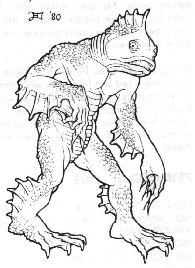
The Deep Ones are humanoid, amphibious man-fish, cold-blooded creatures of great strength. They can attack with their clawed, webbed hands or wield weapons. They live near the land on ocean shelves and are able to travel to the land at any time for as long as they wish.

They have been known to interact with evil humans and interbreed with them. This results in human-appearing offspring who undergo a gradual transformation after the age of 21 that causes them to become the Deep Ones who spawned them. The Deep Ones are souless and apparently immortal.

These creatures promote evil in preparation for their master Cthulhu’s return. THey do this by collecting treasures from the sea and using them as funds to spread the cult of Cthulhu and the Great Old Ones.

While you could just substitute the stats for other fish-men like the Sahuagin or Kuo-toa for Deep Ones, here is an attempt to adapt the Deep Ones from Deities and Demigods:

Medium Monstrosity Chaotic Evil
Armor Class:         14 (hide)
Hit Points:         45 (6d8 +18)
Speed:         30 ft, swim 60 ft
STR 18 (+4); DEX 10 (+0); CON 16 (+3); INT 12 (+1); WIS 12 (+1); CHA 6 (-2)
Skills: Arcana +4, Perception +4
Senses: Darkvision 90 ft., passive Perception 14
Languages: Deep One, Common

Actions
Claws: +7 melee weapon, reach 5 feet, 7 (1d6+4) slashing damage and target is grappled.
Spear: +7 melee weapon, reach 5 feet, 7 (1d6+4) piercing damage or 8 (d8+4) piercing damage if used two-handed, range 20ft/40ft if thrown


Great Race
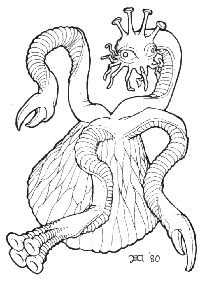
These creatures populated the world eons ago and their cities still exist buried in deserts and other out-of-the-way places. They had a highly advanced scientific civilization, but with psionics rather than magic. When their civilization was destroyed, some of them were frozen in time, and these are occasionally discovered. The Great Race are tall cones, ten feet wide at the base, with four ten-foot long tentacles at the top. Two tentacles end in lobster-like claws, one in trumpet-like ears, and one in a glob with three eyes along its circumference with a set of manipulating tentacles depending from it. The relationship, if any, between the Great Race, the Old Ones, and the elder gods is unclear. Humans discovering and freeing them are sometimes rewarded with gifts of knowledge.


Large Monstrosity Lawful Neutral 
Armor Class: 14 (hide)
Hit Points: 52 (8d10 +8)
Speed: 40 feet
STR 12 (+2); DEX 14 (+2); CON 13 (+1); INT 15 (+2); WIS 14 (+2); CHA 10 (+0)
Skills: Arcana +7, Investigation +7, Perception +7
Condition Immunity: charmed, frightened
Senses: Passive Perception 17
Languages: Great Race

Actions
Multiattack: Great Ones may make two claw attacks in a single round.
Claw: +7 melee weapon, reach 10 feet, 8 (1d8+2) slashing damage.

Mi-Go (The Fungi from Yuggoth)
These red, bat-winged creatures somewhat resemble lobsters in that they have many legs, feelers, and eyestalks, and forearms that end in great pincers. Though they appear to be crustaceans, they are actually fungus creatures. Mi-go are immune to the effects of cold, dark and vacuum and can fly across interstellar space. They cannot speak, but communicate by clicking their pincers.

Though they may seem unintelligent monsters, Mi-go are actually very intelligent and have access to advanced technology, such as desiccating rays and the ability to surgically extract and preserve brains.


Large Outsiders Chaotic Evil
Armor Class:         16 (hide)
Hit Points:         52 (7d10 +14)
Speed:         20 feet, 30ft flying
STR 12 (+1); DEX 14 (+2); CON 15 (+2); INT 13 (+1); WIS 12 (+1); CHA 6 (-2)
Skills: Arcana +4, Investigation +4, Perception +4
Condition Immunities: charmed, exhaustion, frightened, poisoned
Damage Resistance: acid, cold
Senses: Darkvision 90 feet, Passive Perception 14
Languages: Mi-go

Fungal Fortitude: Mi-go do not need water, food, or air.
Actions
Multiattack: Mi-go may make two claw attacks in a single round.
Claw: +5 melee weapon, reach 5 feet, 6 (1d8+2) slashing damage.


Primordial One
These creatures are barrel-shaped cylinders with membranous wings. On top of their bodies is a head covered by three-inch wiry cilia of many colors. At the top of their bodies they have 5 red–irised, stalked globular eyes and 5 mouthed tentacles. At the base of their bodies are five powerful tentacles used for mobility.

The primordial ones are actually an alien race of high intelligence and advanced science. They hate all other types of intelligence and seek to destroy them if possible, striking with three of thei powerful walking tentacles if no advanced weaponry is available.

Large Monstrosity Chaotic Evil
Armor Class: 14 (hide)
Hit Points: 75 (10d10 +20)
Speed: 40 feet, 30ft flying
STR 12 (+1); DEX 14 (+2); CON 15 (+2); INT 13 (+1); WIS 12 (+1); CHA 6 (-2)
Skills: Arcana +4, Investigation +4, Perception +4
Condition Immunities: charmed
Damage Resistance: cold, fire
Senses: Darkvision 90 feet, Passive Perception 14
Languages: Primordial One

Actions
Multiattack: Primordial Ones may make three tentacle attacks in a single round.
Tentacle: +7 melee weapon, reach 5 feet, 5 (1d6+2) bludgeoning damage.

 
Shoggoth
Originally created by the Primordial Ones as servants, the shoggoths eventually rebelled and destroyed the civilization of their masters. Shoggoths resemble huge, intelligent amoebae, able to form almost any shape out of their near-transparent bodies, including legs, eyes, mouths, huge weapons or whatever is needed. The few remaining Shoggoths lure in distant, long-deserted cities, sometimes aiding servants of Cthulhu or other Great Old Ones.

Large Monstrosity Chaotic Evil
Armor Class: 14 (hide)
Hit Points: 52 (20d10 +14)
Speed: 20 feet, 30ft flying
STR 16 (+3); DEX 10 (+0); CON 15 (+2); INT 8 (-1); WIS 10 (+0); CHA 2 (-4)
Condition Immunities: charmed, exhaustion, frightened, paralyzed, poisoned.
Senses: Darkvision 90 feet, Passive Perception 14
Languages: Primordial One

Magic Resistance: Flame Creatures have advantage to saving throws made agains spells and magical effects.

Actions
Multiattack: Shoggoths may make two pseudopod attacks in a single round.
Pseudopod: +13 melee weapon, reach 10 feet, 19 (3d10+3) slashing damage.
Print